

Jamie O'Sullivan
Qualitative Research Manager
Recruiting the right participants is a major challenge in complex B2B research. Common tools like keyword searches and job title filters lack the precision required for this work.
This gap is significant. Two professionals with the same job title may have different responsibilities, seniority, and relevance to a research topic. In specialist B2B studies, especially in niche industries or with hard-to-reach audiences, surface-level search is insufficient.
The Problem with Conventional Participant Search
Traditional database searches rely on exact or near-exact keyword matches. They may list “Senior Procurement Managers” without distinguishing between those who approve supplier contracts and those who manage vendor relationships in a specific category.
This approach may suffice for general consumer studies. In specialist B2B qualitative recruitment, however, it risks including unsuitable participants, missing key candidates, and wasting time on irrelevant profiles.
Where RONIN Edge Makes a Difference
As Qualitative Research Manager, I see RONIN Edge directly improving our recruitment process.
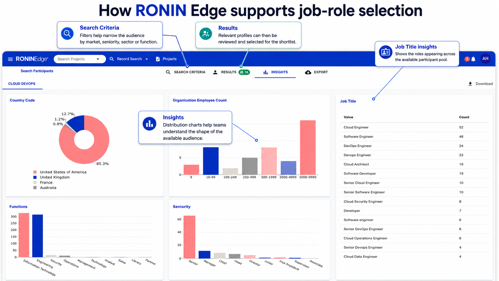
RONIN Edge combines AI-supported semantic search with structured participant data from a validated database of over 400,000 professionals in more than 80 markets and 40 languages. Instead of relying solely on keywords, it interprets meaning and context to identify participants whose experience matches research objectives, even if their job titles differ from expected terms.
Tasks that once required extensive manual profile review are now streamlined, enabling our teams to identify relevant participants more quickly while maintaining the quality and precision our clients expect.
Human Judgement Remains Central
It’s worth being clear about what this means. RONIN Edge does not replace the judgement of experienced qualitative recruitment teams. It supports them by helping pinpoint candidates who might otherwise be overlooked through conventional search methods, and by redirecting the team’s attention toward the work that benefits most from human expertise.
This includes validating suitability, understanding nuance, assessing fit against the research brief and ensuring participants have the right experience to contribute meaningfully to the study.
Semantic Search in Practice
One recent project highlighted the impact semantic search can have on large-scale B2B recruitment. RONIN was tasked with delivering more than 600 qualitative interviews, engaging senior stakeholders across government, trade, investment and SME audiences.
The study aimed to establish an understanding of global awareness and engagement, identify the factors influencing a city’s attractiveness and assess competitive perception among key decision-makers.
Given the scale and complexity of the recruitment, RONIN Edge’s semantic search capabilities played a critical role in delivery. Rather than relying solely on job titles or keywords, the platform helped identify participants based on contextual relevance and professional expertise, allowing our teams to quickly locate candidates who were a strong fit for the research objectives.
The Result: Better Recruitment, Faster
Across our specialist B2B projects, the impact has been significant. We reach the right audiences more reliably and spend less time on manual screening. Because our shortlists are based on contextual relevance rather than keyword matches, the quality of in-study conversations has also improved.
For qualitative teams working with hard-to-reach B2B audiences, this level of precision is essential. It determines whether a study succeeds or falls short.